

How to Run a Vet‑Supervised Elimination Diet for Your Dog
How to Run a Vet‑Supervised Elimination Diet for Your Dog
When itching, ear trouble, or gut upsets keep returning, guesswork rarely helps. A structured elimination diet brings clarity and protects your dog’s comfort.
Food reactions may mimic other problems. A precise, vet-supervised plan removes noise and reveals triggers. In this guide, you will learn a step‑by‑step protocol, timelines, allowed foods, record‑keeping, and safety boundaries.
Why an elimination diet and when it’s appropriate
Link to our orientation guide on food allergies for context
Elimination diets remain the reference approach for diagnosing diet-related reactions because they isolate variables and test responses methodically. This method helps separate food issues from environmental triggers and secondary infections with clear logic and timelines.[4]
For a broader primer before you start, see our orientation guide on food allergies. It explains why an elimination trial is often considered the gold-standard diagnostic step.
Who qualifies: symptoms and differential checks before starting
Consider a dog food elimination diet when your vet suspects diet-responsive itch, recurrent ear inflammation, chronic soft stools, or vomiting without a clear infectious cause. Rule out fleas, mites, and overt skin infections first. Your vet may also screen for environmental allergies.
Stable baseline health improves test clarity. Use your vet’s symptom checklist and ensure medications are aligned with the trial. If you need help identifying relevant signs, review our Symptoms Checklist: Is Your Dog Showing Signs of a Food Allergy?
Step‑by‑step protocol agreed with your vet
Select the diet: novel vs hydrolysed, treats and chews policy
Your vet will recommend a novel protein diet for dogs using proteins and carbohydrates your dog has never eaten, or a hydrolysed diet for dogs where proteins are broken into smaller peptides that may be less immunogenic.[4]
Both approaches are valid. Selection depends on diet history, availability, and household practicality. Treats and chews are generally paused unless they match the exact trial formula. For protein ideas, see Is Buffalo a Good Novel Protein for Dogs with Food Allergies?
Strict feeding plan: quantities, water, medications, supplements
Feed only the prescribed diet. Set daily rations based on maintenance energy needs from your vet, or approximately 2–3% of body weight for raw-style plans if advised. Split into two or three meals.
Offer unlimited fresh water. Avoid flavoured medications, palatable toothpastes, table scraps, and unvetted supplements. If medication is essential, ask your vet for allergen-safe formulations or capsules without flavourings.
Timeline: 0–14 days stabilisation, 4–8 weeks assessment
Days 0–14 aim for gastrointestinal stability and reduced itch intensity. By weeks 4–8, many dogs show clearer improvement, forming the core dog allergy trial timeline. Shorter protocols can reduce accuracy and risk equivocal results.[1][4]
Your vet may adjust length based on response and seasonality. Adherence to feeding rules is a critical success factor for diagnostic clarity.[2]
Reintroduction phase: single‑ingredient food challenges
After improvement, you will reintroduce one ingredient at a time for 3–7 days while monitoring for flares. Begin with the most likely culprits. Maintain unchanged environment, grooming products, and routines during each challenge.
Agree on the order with your vet and keep meticulous logs. For structure during this stage, see Reintroduction After the Elimination Diet: Building a Long‑Term Plan.
Allowed foods and what to pause during the trial
Core diet examples (vet‑approved only)
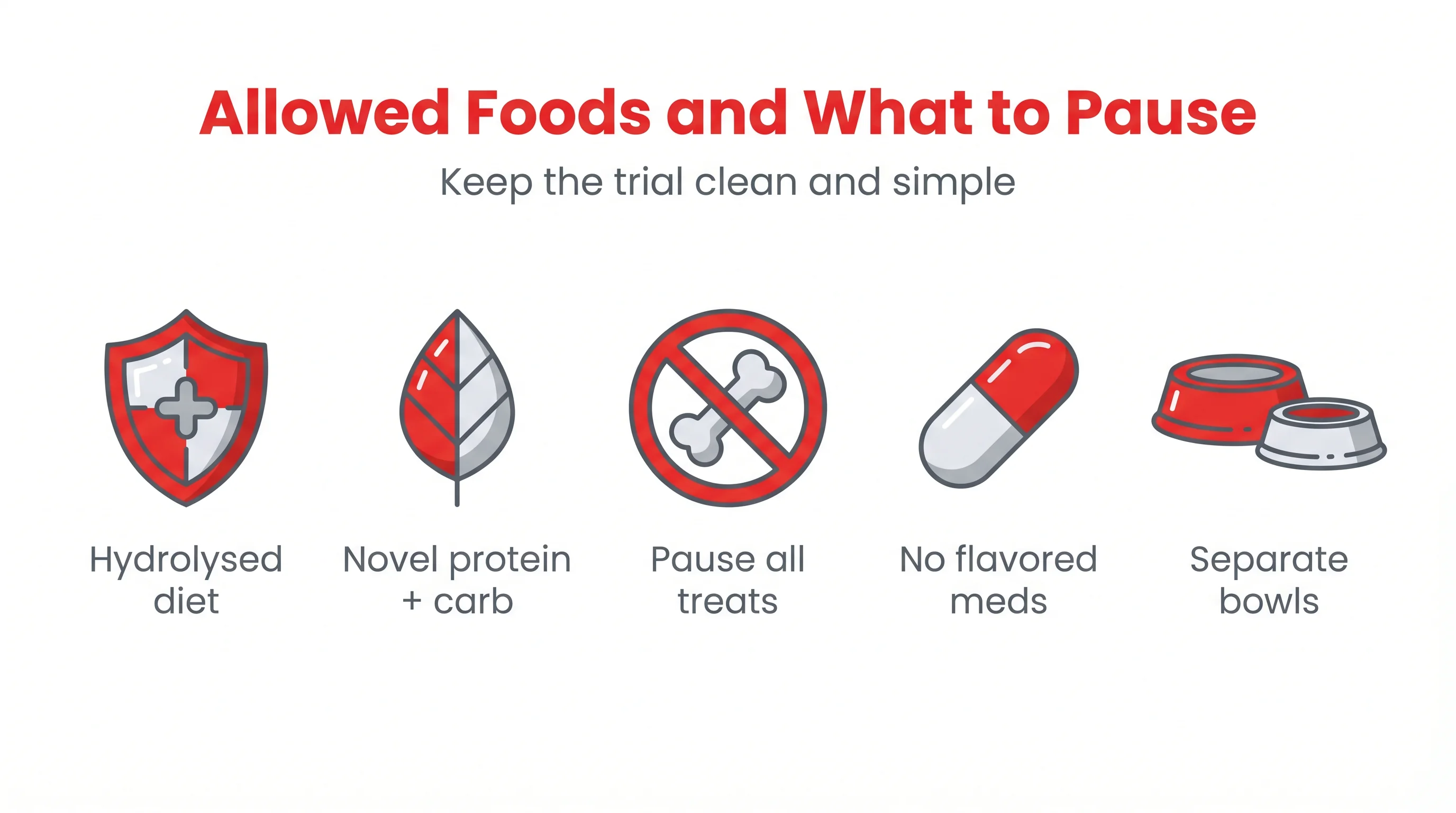
Examples include a veterinary hydrolysed diet, or a home‑prepared novel combination such as venison and sweet potato, or insect protein with a single carbohydrate. Use one protein and one carbohydrate initially for clarity.
Stick to complete and balanced veterinary diets unless your vet oversees home formulation. If home‑cooked, your vet may add a canine multivitamin and essential fatty acids to maintain adequacy without confounding ingredients.
Treats, chews and extras: what to avoid and permitted alternatives
Pause all unapproved treats. Avoid stock cubes, gravy, flavoured medications, dental sticks with mixed proteins, broth toppers, and peanut butter. Use measured portions of the trial diet as rewards whenever possible.
If your vet approves buffalo as the trial protein, single‑ingredient jerky can be practical. Many owners use Buffalo Meat Jerky - Dog Treats sparingly as a matched protein reward. For label literacy, see How to Read Dog Treat Labels for Allergy Safety and trial‑friendly options in Safe Treats During an Elimination Trial: What’s In, What’s Out.
Record‑keeping that helps your vet make decisions
Daily log template: stool, skin, itch, ears, energy, weight
Use a single page per day. Record meals, amounts, and any deviations. Score itch 0–10, note scratching episodes, paw licking, redness, and ear debris. Track stool quality using a 1–7 scale and count bowel movements.
Capture energy level, appetite, and weight weekly. Include medications and timing. Owner adherence and detailed logs meaningfully influence diagnostic outcomes in elimination trials.[2]
Photo timelines and how to measure change objectively
Photograph the same sites weekly: armpits, groin, paws, belly, and ears. Use identical lighting and angles. Date‑stamp images and store alongside your log. Compare week‑to‑week to avoid recall bias.
Measure lesions or hotspots with a ruler in frame. For coats, part the hair and photograph skin directly. Consider a shared folder for your vet to review between check‑ins.
Quick decision guide
If X then Y: 5–7 common situations and next actions
- If your dog refuses the new diet for 24 hours, contact your vet. Discuss palatability options or warming food rather than switching formulas unilaterally.
- If vomiting occurs more than twice in a day, pause new foods and call your vet to rule out gastroenteritis or adjust transition speed.
- If itch worsens sharply after a known scavenging incident, reset the trial clock from that date and document the exposure.
- If stools are loose for over 48 hours, discuss probiotic use or fibre adjustments with your vet without altering the core protein/carbohydrate.
- If mild improvement appears by week two, continue strictly through week eight before judging success to avoid false negatives.[1]
- If weight drops more than 5% in two weeks, increase calories under vet guidance and re‑check body condition.
- If ear odour or discharge persists, schedule a vet ear cytology to manage secondary infection without derailing diet integrity.
Monitoring: what to look for at 7–14 days and 4–8 weeks
Short‑term checkpoints
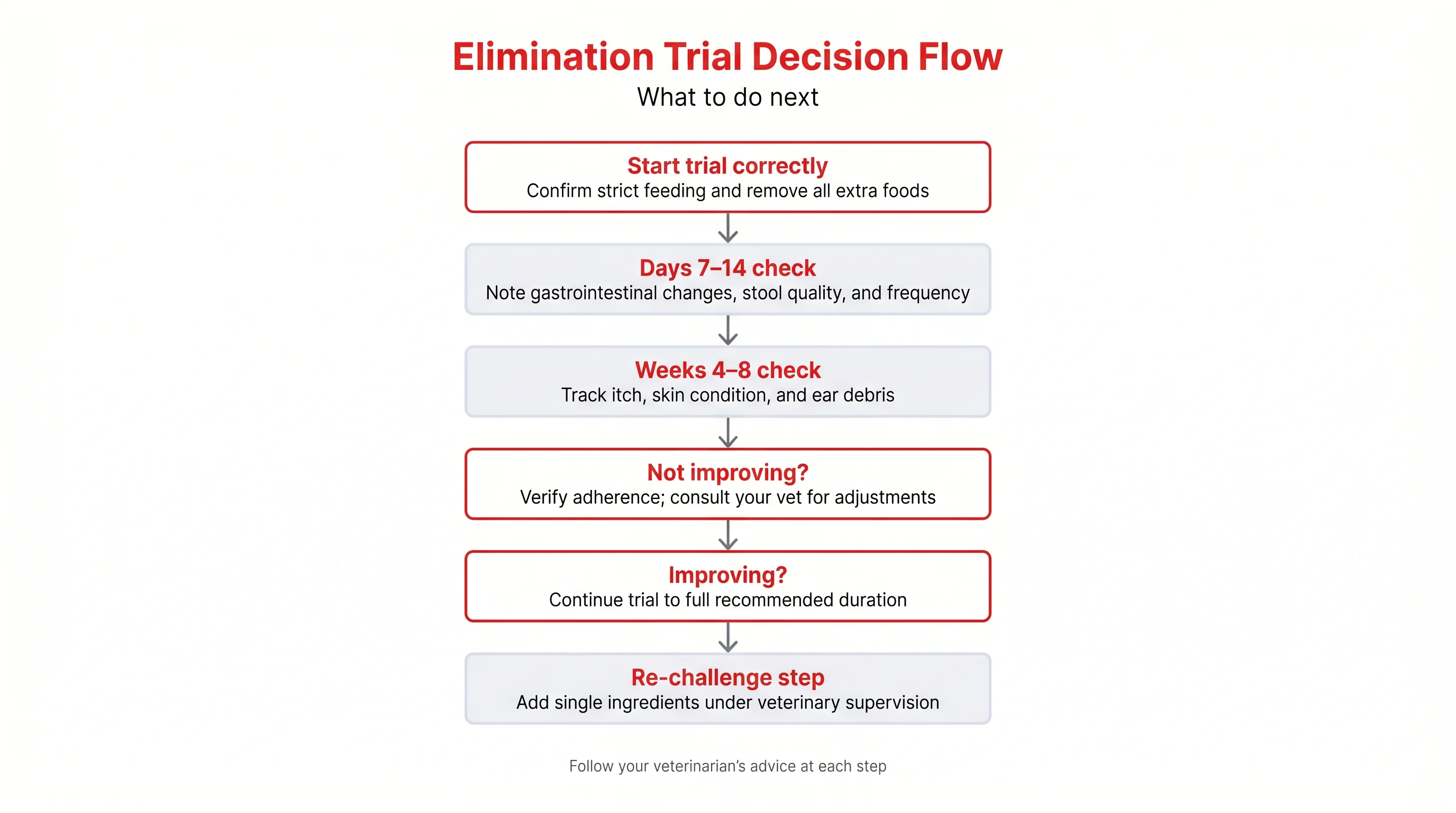
By days 7–14, gastrointestinal signs may stabilise first. Expect fewer bowel movements, firmer stools, and reduced gas. Itching may soften in intensity, even if frequency fluctuates with habits or weather.
Note any partial gains. Keep environmental variables steady. Record exact dates, as these guide your vet’s interpretation of the developing response curve during the dog food elimination diet.
End‑of‑trial evaluation with your vet
At 4–8 weeks, review logs and photos with your vet. Evidence suggests this window best distinguishes diet response while balancing owner feasibility.[4]
Your vet will grade improvement, confirm adherence, and plan reintroduction. Shortened protocols may reduce diagnostic confidence, which is vital if your dog has overlapping environmental sensitivities.[1]
Practical safety boundaries
When to stop the trial and call your vet
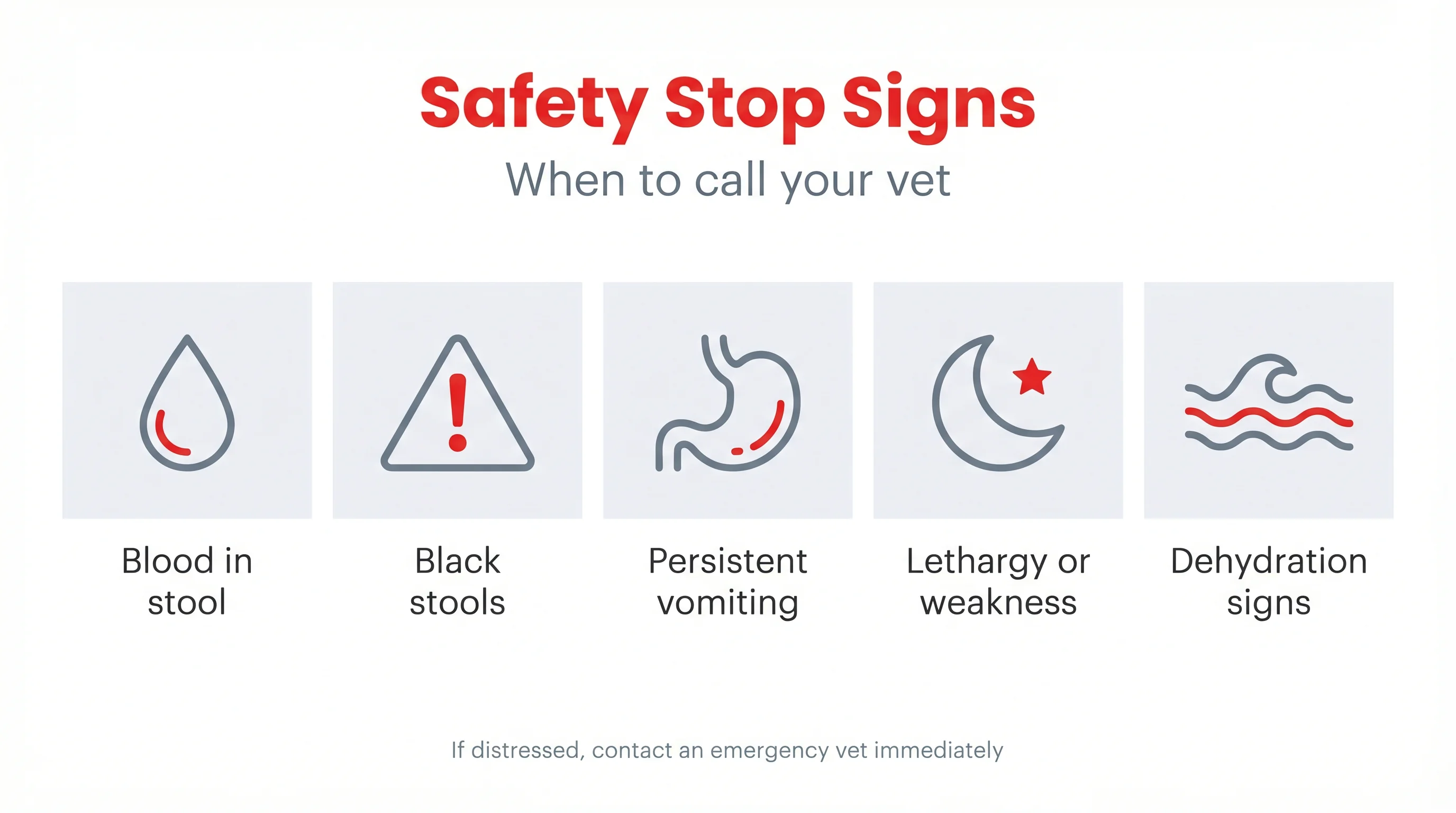
Stop and seek veterinary advice if your dog shows persistent vomiting, diarrhoea with blood, black stools, lethargy, rapid weight loss, worsening ear pain, or spreading skin infection. These may indicate complications requiring prompt care.
If your dog appears distressed or dehydrated, contact your vet or an emergency service immediately. Safety always overrides diagnostic schedules and theoretical timelines.
Avoiding hidden ingredients, cross‑contact and underfeeding
Prevent cross‑contact by using clean bowls, utensils, and storage containers. Keep household foods and pet foods physically separated. Avoid pet shops handing out unvetted samples during the trial.
Scrutinise labels for stock, fats, gelatin, “animal derivatives,” or mixed proteins. Weigh meals to maintain calories. Underfeeding can confound results by causing lethargy, weight loss, and coat dullness unrelated to allergy control.
Evidence status: what research suggests
Strength of evidence for elimination diets in suspected food allergy
Veterinary literature supports elimination trials as the primary diagnostic tool for canine food allergies, leveraging controlled exposure and re‑challenge to confirm adverse food reactions.[4]
Shortened trial protocols may improve owner compliance but can reduce sensitivity and specificity compared with longer durations, so vet guidance on timing is essential.[1]
Where evidence is mixed and why vet oversight matters
Emerging options, like elemental or extensively hydrolysed diets, show promise but have limited comparative data versus classic approaches, and results may vary across populations.[3]
Owner adherence, flavour‑masked medications, and incidental exposures are frequent confounders. Vet oversight helps structure the plan, maintain adherence, and interpret borderline responses objectively.[2]
Glossary and prep checklist
Key terms owners will encounter
- Novel protein: A meat your dog has never eaten before, used to reduce immune recognition.
- Hydrolysed diet: Proteins enzymatically broken into smaller fragments that may reduce allergenicity.
- Re‑challenge: Controlled reintroduction of a single ingredient to confirm sensitivity.
- Cross‑contact: Unintended mixing of allergens via utensils, surfaces, or storage.
- Adherence: Following the plan exactly, without unapproved foods or treats.
One‑page prep list for day 0
- Vet‑approved diet and measured feeding plan in grams per meal.
- Written list of allowed foods, safe medications, and emergency contacts.
- Digital daily log and photo schedule with weekly body weight checks.
- Clean bowls, storage containers, and separate prep area to prevent cross‑contact.
- Household briefing so everyone follows the same rules without exceptions.
- Pre‑booked check‑ins for week two and end‑of‑trial evaluation.
Frequently Asked Questions
How long should a dog’s elimination diet last before reintroduction?
Many vets recommend 6–8 weeks before challenging with single ingredients. Some dogs show early improvement by 2–4 weeks, but premature reintroduction may blur results.
Can my dog have treats or chews during an elimination diet?
Only if they match the exact trial protein/carbohydrate or are specifically approved by your vet. Unapproved treats may introduce allergens and reset the clock.
What’s better: a novel protein or a hydrolysed diet?
Both approaches may help. Novel proteins avoid suspected triggers, while hydrolysed diets reduce peptide size to lessen immune recognition. Your vet will advise based on history and availability.
When should I stop the trial and contact my vet?
If vomiting, diarrhoea with blood, lethargy, rapid weight loss, worsening skin infection, or ear pain occurs, pause the trial and contact your vet for guidance.
How do I confirm which ingredient is the problem?
After improvement on the trial diet, reintroduce one ingredient at a time for 3–7 days while logging symptoms. A consistent flare after a specific ingredient may indicate sensitivity.
Final thought: A vet‑supervised elimination diet replaces uncertainty with structured evidence. Agree the plan, control every bite, and document changes meticulously. With clear timelines, cautious reintroduction, and disciplined record‑keeping, you can identify food triggers and build a long‑term, reliable diet. The Buffalo Co. supports ingredient transparency and careful feeding practices, so you can focus on your dog’s comfort and measurable results.
References
- N Fischer et al. (2021). Sensitivity and specificity of a shortened elimination diet protocol for the diagnosis of food‐induced atopic dermatitis (FIAD). Veterinary …. View article
- MR Painter et al. (2019). Use of the Health Belief Model to identify factors associated with owner adherence to elimination diet trial recommendations in dogs. Journal of the American …. View article
- J Tinsley et al. (2024). An open‐label clinical trial to evaluate the efficacy of an elemental diet for the diagnosis of adverse food reactions in dogs. Veterinary …. View article
- RS Mueller et al. (2018). Adverse food reactions: Pathogenesis, clinical signs, diagnosis and alternatives to elimination diets. The veterinary journal. View article